By Molnár-Institute for…
Subscribe to Supplier
Subscribe to Supplier

Presenting multidimensional modelling to solve chromatographic challenges at EAS 2025
Berlin: – The MOLNÁR-INSTITUTE for Applied Chromatography is pleased to announce its return to the Eastern Analytical Symposium (EAS), held in Plainsboro, New Jersey, USA, as both an exhibitor and a contributor to the scientific program.
Arnold Zöldhegyi, researcher and application specialist at the MOLNÁR-INSTITUTE, will present a compelling talk on the application of 3D design space modeling using DryLab® software to address common chromatographic challenges. His presentation, titled “Employing Multidimensional Design Space Modeling Across Frequent Chromatographic Challenges-Use Cases from Recently Published Results,” will showcase practical insights drawn from recent case studies.
This presentation will be featured in the session “Modern HPLC Approaches: Method Optimization, Sustainability, and Selectivity,” chaired by Mariann Neverovitch of Bristol Myers Squibb, scheduled for the second morning of the conference-Tuesday, November 18.
Design Spaces as Digitalized Fingerprints
As part of his research, Arnold Zöldhegyi will present a series of use cases developed in collaboration with Krisztián Horváth (Pannon University), Róbert Kormány (Egis Pharmaceuticals), and Dr. Imre Molnár, President of the MOLNÁR-INSTITUTE. Their study illustrates how modeling tools based upon systematic knowledge – aligned with Analytical Quality by Design (AQbD) principles—can effectively support both proactive prevention and reactive troubleshooting of robustness failures in HPLC method development.
Arnold will emphasize how DryLab® 4 modeling software uniquely combines chromatographic fundamentals with a minimal set of input experiments to construct experimentally calibrated Design Spaces (DS). These digitized models act as system-specific ‘fingerprints,’ enabling detailed evaluation of parameter settings, method transferability, robustness testing, and – more recently – systematic comparisons of complete separation systems.
Comparing Design Spaces
His presentation will also present a range of Design Space Comparison (DSC) strategies for addressing challenges such as identifying suitable replacement columns, comparing different stationary phase chemistries, evaluating batch-to-batch inconsistencies, mitigating system-to-system differences, and managing transferability issues between volatile and non-volatile buffer systems.
Together, these case studies highlight the importance of a detailed, multidimensional understanding of method parameters—and their continuous, targeted fine-tuning-for achieving and maintaining consistent analytical performance.
DryLab® on show
Meanwhile, the MOLNÁR-INSTITUTE for Applied Chromatography will once again exhibit from its familiar location at Booth L3 at the Crowne Plaza Princeton Conference Center. The booth will feature the latest advancements in DryLab® 4 software for (U)HPLC modeling, continuing the institute’s 39-year legacy of revolutionizing chromatographic method development.
Exhibits will demonstrate how DryLab’s modelling suite supports a knowledge-driven, scientifically sound method development across various fields of pharmaceutical industry. Visitors will discover how the software empowers analytical scientists to interpret complex separation processes, reduce runtimes, and assess method robustness-all while aligning with Analytical Quality by Design (AQbD) principles.
About The MOLNÁR-INSTITUTE
Founded in 1981, The MOLNÁR-INSTITUTE develops DryLab®4, a software for UHPLC modelling for a world-wide market. Its powerful modules gradient editor, peak tracking, automation, robustness and Design Space Comparison allow for the most sophisticated method development as required across modern pharma industries. Analytical scientists use DryLab®4 to understand chromatographic interactions, to reduce analysis time, to increase robustness, and to conform to Analytical Quality by Design (AQbD) principles, according to the recently published ICH Q14 regulatory framework.
The MOLNÁR-INSTITUTE is a registered partner of the US-FDA, CDC and many other regulatory bodies. DryLab®4 pioneered AQbD long before regulatory agencies across the world encouraged such submissions. Widely implemented by thought leaders, the software contributes substantially to the paradigm shift towards a science and risk driven perspective on HPLC Quality Control and Assurance.
Further information at: http://www.molnar-institute.com/
About EAS 2025
The Eastern Analytical Symposium and Exposition (EAS) is held each year to provide professional scientists and students working in the Eastern USA with continuing education in the analytical and allied sciences through the presentation of symposia of papers, workshops, and short courses.
Over half a century, the EAS Technical Program has provided cutting-edge information for the analyst with research presentations on practical and novel technologies. The symposium now typically contains more than 450 papers on a wide variety of subjects, from pharmaceutical analysis to art conservation, emphasizing practical applications of a wide range of technologies including Liquid chromatography, Raman spectroscopy, microscopy, and sensors in solving real-life problems,
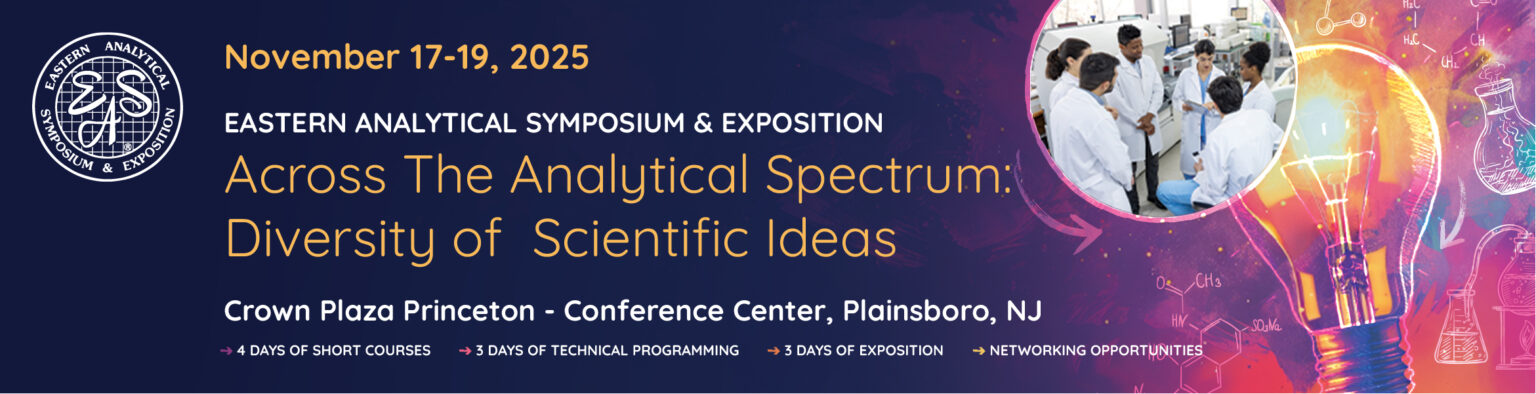
The 2025 EAS Symposium will again be a three-day event, opening November 17 at the Crowne Plaza Princeton Conference Center in Plainsboro, NJ. The 2025 conference will be themed ‘Across the Analytical Spectrum: Diversity of Scientific Ideas’ as a celebration of the rich diversity to solve the most pressing challenges in science.
The conference will include technical sessions, short courses, special lectures, workshops and student seminars, as well as a co-located exhibition of analytical science apparatus and supplies.
The event is organised by EAS with further information available at: https://eas.org
Resources
Click on DryLab®- Software for Analytical Design Space Modeling for further information.

Arnold Zöldhegyi, Researcher and Application Specialist at Molnár-Institute for Applied Chromatography.
Related Articles