By Molnár-Institute for…
Subscribe to Supplier
Subscribe to Supplier

Overcoming LC Separation Challenges for Oxysterols
Berlin: – The MOLNÁR-INSTITUTE for Applied Chromatography has contributed to an Italian-led research project focused on optimizing LC methods for the separation and analysis of oxysterols – important biomarkers involved in various biological processes and serious diseases.
The study, “Overcoming Challenges in LC Separation of Oxysterols through Guided Design Space Modelling: A Comparison of Three Stationary Phases,” was led by Dr. Andrea Castellaneta and Professor Ilario Losito of the University of Bari and published in the Journal of Chromatography A (see Resources).
The MOLNÁR-INSTITUTE team, led by Dr. Imre Molnár and including Arnold Zöldhegyi, Zuzana Hrušovská, and Hans-Jürgen Rieger, contributed through advanced analytical Design Space modeling using the DryLab® software platform. The modeling approach enabled a systematic comparison of reversed-phase LC separations of ten clinically relevant oxysterols, including challenging isomeric ring-oxidized and side-chain-oxidized sterols.
Common challenges in the analysis of Oxysterol
Oxysterols are oxidized derivatives of cholesterol that play important roles in various biological processes and serve as potential disease biomarkers. Initially regarded primarily as intermediates in bile acid biosynthesis, oxysterols are now recognized as key signaling molecules implicated in pathologies such as atherosclerosis, neurodegenerative disorders, and cancer.
Despite their biological relevance, oxysterols pose significant analytical challenges. Their concentrations in commonly investigated biological matrices (e.g., plasma, cells, and tissues) are typically 3-4 orders of magnitude lower than those of cholesterol. Accordingly, stringent precautions must be adopted during sample preparation to prevent even minimal oxidative conversion of endogenous cholesterol, which may otherwise result in artifactual oxysterol formation. Furthermore, their low abundance generally necessitates the implementation of highly sensitive mass spectrometry (MS)-based analytical approaches to ensure reliable qualitative and quantitative determination. Nevertheless, MS detection is intrinsically complicated by the occurrence of oxysterols in multiple isomeric forms, which are not readily distinguishable along the MS dimension alone.
Overcoming LC Separation Challenges
Within the current research scope, the team prioritized a liquid chromatography–mass spectrometry (LC–MS) approach over gas chromatography–mass spectrometry (GC–MS) for oxysterol analysis. Unlike GC–MS, which typically requires a chemical derivatization step during sample preparation – potentially introducing derivatization artifacts – LC-MS enables more direct analysis of native compounds.
However, MS characterization of underivatized oxysterols is further complicated by the tendency of these compounds to undergo extensive in-source fragmentation when typical atmospheric pressure ionization techniques (e.g., ESI and APCI) are exploited. This may determine the formation of isomeric fragment ions even from non-isomeric and often undetectable precursors. Therefore, MS-based identification alone remains highly challenging-even when using high-resolution instruments-unless sufficient chromatographic separation is achieved. In this context, separation profiling was streamlined through the application of DryLab® analytical Design Space modeling, enabling visualization and systematic optimization of the separation of ten clinically relevant oxysterols. A total of twelve scouting experiments were performed to evaluate combinations of key parameters, including column temperature, gradient steepness, and organic modifier composition.
Experimental data were generated using three identically sized core-shell HPLC columns: octadecyl C18, pentafluorophenyl (F5), and cyanopropyl (ES-CN) – the latter applied for the first time in reversed-phase mode for oxysterol analysis. The resulting datasets were processed using DryLab® software for structured method evaluation, with particular emphasis on mapping the separation potential across the targeted oxysterol species. The C18 phase provided the highest selectivity, whereas the ES-CN and F5 phases enabled significantly shorter run times, reducing total analysis time to under 45 minutes.
Promising results
The study results highlighted the inherent challenges in separating structurally similar and isomeric oxysterols, particularly difficult pairs such as 7α-hydroxycholesterol (7α-HC) and 7β-hydroxycholesterol (7β-HC), as well as 25-HC and 24(S)-HC. Despite these challenges, the team successfully developed and optimized analytical methods for clinically relevant oxysterols. Optimal chromatographic conditions were established for all three stationary phases, achieving an excellent retention time modeling accuracy of 99.5%.
Among the tested phases, the F5 column provided particularly clean separation of 3β,5α,6β-cholestantriol from side-chain–oxidized oxysterols, while the ES-CN phase offered a favorable balance between analysis time and baseline stability.
Overall, the findings underscore the effectiveness of chromatography-based modeling approaches in the development of methods for structurally similar compounds and demonstrate the complementary selectivity profiles of different stationary phases in oxysterol analysis.
The authors also identified potential avenues for further improvement, including adjustments to flow rates and column geometries to enhance separation efficiency and further reduce analysis time. In addition, they emphasized the need for future studies to explore the biochemical relevance of additional oxysterol species not included in the present investigation.
About Molnár-Institute
Founded in 1981, The MOLNÁR-INSTITUTE develops DryLab®4, a software for UHPLC modelling for a world-wide market. Its powerful modules gradient editor, peak tracking, automation, robustness and Design Space Comparison allow for the most sophisticated method development as required across modern pharma industries. Analytical scientists use DryLab®4 to understand chromatographic interactions, to reduce analysis time, to increase robustness, and to conform to Analytical Quality by Design (AQbD) principles, according to the recently published ICH Q14 regulatory framework.
The MOLNÁR-INSTITUTE is a registered partner of the US-FDA, CDC and many other regulatory bodies. DryLab®4 pioneered AQbD long before regulatory agencies across the world encouraged such submissions. Widely implemented by thought leaders, the software contributes substantially to the paradigm shift towards a science and risk driven perspective on HPLC Quality Control and Assurance.
Further information at: http://www.molnar-institute.com/
Resources
Click on Overcoming challenges in LC separation of oxysterols through guided design space modelling: A comparison of three stationary phases to access original JCA article.
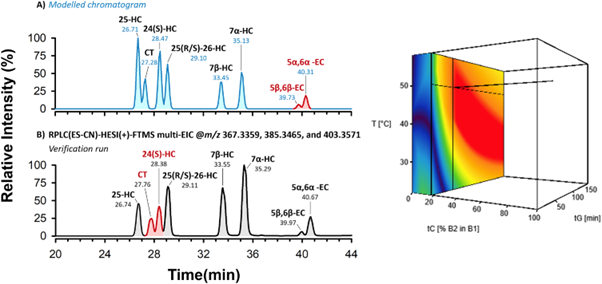
Comparison between the modelled chromatogram generated by DryLab® (Panel A) and the corresponding RPLC for the ES-CN column plus FTMS verification chromatogram (Panel B). In both panels, the less resolved peaks (i.e., the peak pair corresponding to the critical resolution value) are highlighted in red. Modelled and observed retention time values are shown below each peak label to better evaluate the prediction accuracy of DryLab®. The 3D color map on the right) shows the dependency of the critical resolution value on the three factors selected for the optimization.
Related Articles