By Molnár-Institute for…
Subscribe to Supplier
Subscribe to Supplier

Phenomenex India Applies DryLab® in AQbD-Based Stability Profiling of Valsartan and Sacubitril Tablets
Berlin: – The India-based research center of Phenomenex has successfully utilized DryLab® 4 chromatographic modeling software—developed by Berlin’s Molnár-Institute for Applied Chromatography—to improve the stability profiling of Valsartan and Sacubitril tablet formulations.
This work, published as a technical application note by Dr. Rajesh Babu Dandamudi and Dr. Bryan Tackett at the Phenologix Lab, showcases how DryLab® facilitated an AQbD (Analytical Quality by Design) approach to develop a robust and easily adaptable analytical procedure. The strategy further allowed for quick and precise identification of critical method variables effectively overcoming the absence of compendial methods for similar complex combination drug products.
Defining Analytical Goals
Valsartan angiotensin II receptor blocker (ARB) and Sacubitril Neprilysin inhibitor form a combination treatment for hypertension and heart failure. The impurities arising from acid degradation of Valsartan and Sacubitril in the tablets introduce unique challenges, necessitating a method specifically tailored to these formulations.
The method development challenge was to comprehensively understand the impact of various factors on method performance, select the appropriate column, mobile phase, and detection conditions, and establish a method that meets the stringent regulatory requirements for related substances determination.
Therefore, the key aim of the study was to develop a stability indicating method that could reliably separate Valsartan and Sacubitril without any interferences from degradants in the stability sample.
Systematic Method Development Strategy
A preliminary chromatographic run was performed on a diluted mixture of both drug compounds using a Kinetex™ 5 μm F5 column. Under acid stress conditions, approximately 18% degradation of the main peaks was observed, along with the emergence of multiple degradation products.
The subsequent screening phase of method development was guided by an early risk assessment, focusing on critical variables such as mobile phase pH, column chemistry, and run time. The most favorable outcome from these experiments supported the use of a Kinetex™ F5 column with 10 mM potassium dihydrogen phosphate buffer at pH 2.5 as mobile phase A, and acetonitrile as mobile phase B.
Building on these findings, DryLab® 4 AQbD software was employed to construct a 3D model (Figure 1), enabling comprehensive exploration of separation options within the modeled Design Space. Further optimization included evaluating the impact of gradient time (tG), column temperature (T) across a range of 25–55 °C, and ternary organic composition (tC), specifically the proportion of methanol in acetonitrile as the strong solvent. The initial gradient composition was adjusted to begin at 35% mobile phase B, as no analyte peaks were detected between 5% and 35% B under the screening conditions.
Design Space Modeling Results
The resulting 3D Design Spaces revealed broad ranges of suitable pH and column temperature, while underscoring the significant impact of mobile phase composition and gradient steepness on overall separation performance. Notably, column temperature was not identified as a critical factor within the tested range of 25–55 °C.
Based on these insights, a final setpoint was established using a Kinetex™ F5 column, with a column temperature of 40 °C, a strong solvent composition of 100% acetonitrile, and a 10 mM potassium dihydrogen phosphate buffer at pH 2.5 (Figure 2).
Overall, the systematic AQbD-based approach applied in this study significantly deepened the understanding of critical method variables, thereby minimizing the likelihood of setbacks during subsequent method validation and transfer. This strategy facilitated the rapid development of a robust, high-performing analytical procedure while maximizing the resolving capabilities of the Kinetex™ F5 column.
About MOLNÁR-INSTITUTE
Founded in 1981, Molnár-Institute develops DryLab®4, a software for UHPLC modelling for a world-wide market. Its powerful modules gradient editor, peak tracking, automation, robustness and Design Space Comparison allow for the most sophisticated method development as required across modern pharma industries. Analytical scientists use DryLab®4 to understand chromatographic interactions, to reduce analysis time, to increase robustness, and to conform to Analytical Quality by Design (AQbD) principles, according to the recently published ICH Q14 regulatory framework.
The Molnár-Institute is a registered partner of the US-FDA, CDC and many other regulatory bodies. DryLab®4 pioneered AQbD long before regulatory agencies across the world encouraged such submissions. Widely implemented by thought leaders, the software contributes substantially to the paradigm shift towards a science and risk driven perspective on HPLC Quality Control and Assurance.
Further information at: http://www.molnar-institute.com/
Resources
Click on AQbD Approach to Stability Indicating Method Development for Valsartan Sacubitril Drug Product to open full application note.
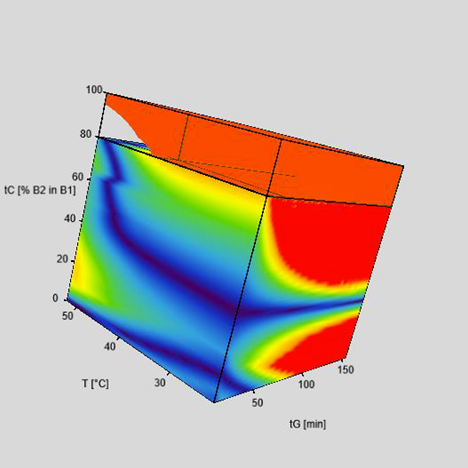
Figure 1: Composite view of the DryLab®-generated 3D separation model using the selected Kinetex™ F5 column. Red regions within the Design Space represent the Method Operable Design Regions (MODRs).
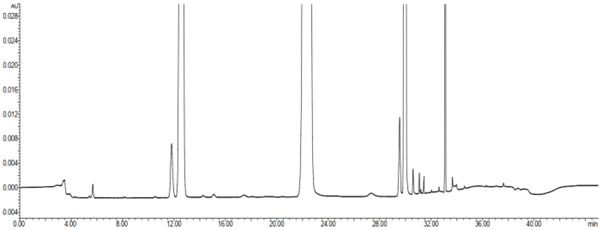
Figure 2: Acquired chromatogram under optimized conditions using the Kinetex™ F5 column.
Related Articles