By Molnár-Institute for…
Subscribe to Supplier
Subscribe to Supplier

Leveraging Modeling to overcoming HPLC Separation Challenges
Berlin: – Chromatography analysis specialist the MOLNÁR-INSTITUTE has played a leading role in a study published in the most recent edition of LCGC International, the leading global chromatography journal, that demonstrates the advantages advanced computer-assisted modeling in modern chromatography.
The study ‘Leveraging Multidimensional Modeling to Resolve Frequent Separation Challenges in HPLC’ shows how exploiting new multidimensional modeling capabilities can resolve many of the frequent challenges in HPLC and UHPLC separations and characterization of substances. It is lead authored by the MOLNÁR-INSTITUTE Senior Scientist Arnold Zöldhegyi, and also involved Institute President Imre Molnár, along with Róbert Kormány of Budapest-based Egis Pharmaceuticals, Krisztián Horváth of Hungary’s University of Pannonia, and Szabolcs Fekete from the Waters Corporation.
Persistent HPLC challenges
The starting point for their review is the acknowledged place of high-performance liquid chromatography (HPLC) and ultra-high-performance liquid chromatography (UHPLC) as the pre-eminent techniques for substance characterization, now routinely employed by thousands of analytical scientists worldwide.
However, despite the long evolution of HPLC/UHPLC hardware, certain challenges persist in achieving robust results, arising from the complex interplay of multiple factors that affect peak retention and separation. These challenges often include batch-to-batch reproducibility of columns or reliable transfer of methods across various instruments.
Toward Advanced Approaches in Separation Modeling
The main thrust of the article is to illustrate how in-silico modeling in liquid chromatography (LC) has evolved over the past half-century – from the pioneering work of Laub and Purnell in the 1970s to today’s diverse suite of sophisticated tools. Among these, the MOLNÁR-INSTITUTE’s DryLab®4 platform stands out by enabling advanced separation modeling through the integration of chromatographic first principles with Design of Experiments (DoE), ultimately supporting in-depth method understanding in alignment with modern Analytical Quality by Design (AQbD) guidelines.
DryLab provided the modeling foundation for a series of Design Space Comparison case studies featured in the article, highlighting the importance of systematic modeling approaches for addressing practical challenges encountered in routine analytical work. A key advantage of multidimensional modeling is its efficiency: only a limited number of initial experiments (typically two or three per factor) are required to calibrate a highly flexible and descriptive model. Once calibrated, the model can accurately represent complete separation patterns, making it valuable not only for method development but also for system characterization and comparative analysis.
Comparative Design Space Modeling Studies
The review highlights five different application examples of chromatographic modelling to overcome challenges:
- Column interchangeability: Selectivity control is essential in HPLC, and method validation often requires identifying backup columns with matching selectivity to prevent supply-related disruptions. In this study, five USP L1-type C18 phases with distinct physicochemical properties were compared using 12 calibration experiments per column. Despite these differences, alignment of the modeled MODRs revealed a shared region where equivalent separation conditions could be achieved, demonstrating interchangeable chromatographic performance in terms of selectivity, resolution, and elution windows.
- Batch-to-Batch Reproducibility: Despite stringent quality controls, minor batch-to-batch differences in pre-packed columns can still arise, and columns with identical specifications from different vendors may show distinct selectivity profiles. In the next case study, 12 BEH UHPLC columns from different batches were compared using 3D tG–T–pH models, generated with only ~12 hours of lab work. While the MODRs showed strong overall agreement, certain regions of the Design Space exhibited noticeable differences in MODR location and volume, highlighting the importance of systematic batch-to-batch evaluation.
- HPLC System Comparison: Analytical methods are often executed on different brands and types of instruments, making method transfer an essential component of routine application and long-term method sustainability. Technological differences between systems—if not properly accounted for—can significantly influence the success of method transfer. This study presented a systematic comparison of two UHPLC systems using tG–T–tC Design Space models. The models revealed subtle but important differences in their respective MODRs, which could be visualized, mapped, and—importantly—compensated for during method transfer.
- CEX Elution Modes: Reversed-phase and cation-exchange (CEX) chromatography were applied to analyse two COVID-19–relevant mAbs, casirivimab and imdevimab, using ultra-short column formats. Two CEX elution strategies—pH gradient and traditional sodium-chloride (“salt gradient”) elution—were compared using tG–T modeling heat maps. The pH-gradient approach provided superior separation for the charge variants of the F(ab’)₂ fragment, while the salt-gradient method showed slightly better resolution for the charge variants of the sFc region.
- RPLC Buffer Studies: A non-volatile (sodium phosphate) and a volatile (ammonium acetate) buffer were compared across the same nominal pH range (6.0–8.0) using tG–T–pH Design Space models. A notable elution-order change was observed between the systems. Modeling showed that, depending on pH, the buffers behaved interchangeably in the lower pH region (pH < 7) but diverged under more alkaline conditions, where they were no longer viable substitutes.
Extending the Application Scope of DryLab® Modeling
The authors conclude:
“The presented examples highlight the added value of applying systematic modeling approaches to effectively and elegantly address practical challenges commonly encountered in routine analytical work.”
They add: “By following a similarly structured workflow, modeling fingerprints can be constructed and compared across a range of real-world separation scenarios, offering valuable insights into specific multidimensional separation behavior—supporting both characterization and comparative HPLC analysis.”
About Molnár-Institute
Founded in 1981, The MOLNÁR-INSTITUTE develops DryLab®4, a software for UHPLC modelling for a world-wide market. Its powerful modules gradient editor, peak tracking, automation, robustness and Design Space Comparison allow for the most sophisticated method development as required across modern pharma industries. Analytical scientists use DryLab®4 to understand chromatographic interactions, to reduce analysis time, to increase robustness, and to conform to Analytical Quality by Design (AQbD) principles, according to the recently published ICH Q14 regulatory framework.
The MOLNÁR-INSTITUTE is a registered partner of the US-FDA, CDC and many other regulatory bodies. DryLab®4 pioneered AQbD long before regulatory agencies across the world encouraged such submissions. Widely implemented by thought leaders, the software contributes substantially to the paradigm shift towards a science and risk driven perspective on HPLC Quality Control and Assurance.
Further information at: http://www.molnar-institute.com/
About LCGC International
Founded in 1983, LCGC International is the leading global media brand for separation science professionals, enhancing the productivity, efficiency, and the overall value of separation techniques globally. With its commitment to editorial excellence, it has pioneered innovation across a broad portfolio of digital and print platforms.
LCGC monthly print publication, website, newsletters, ebooks, webcasts, interviews, and special issues, provide unbiased peer-reviewed articles, trusted troubleshooting advice, and best-practice applications solutions, while LCGC International covers all key growth areas in the field of separation science. LCGC International’s practical information assists lab-based analytical chemists and influential chromatographers to improve productivity and enhance their proficiency, giving them a competitive advantage for the real-world challenges they face.
Resources
Click on Leveraging Multidimensional Modeling to Resolve Frequent Separation Challenges in HPLC to access original LCGC article.
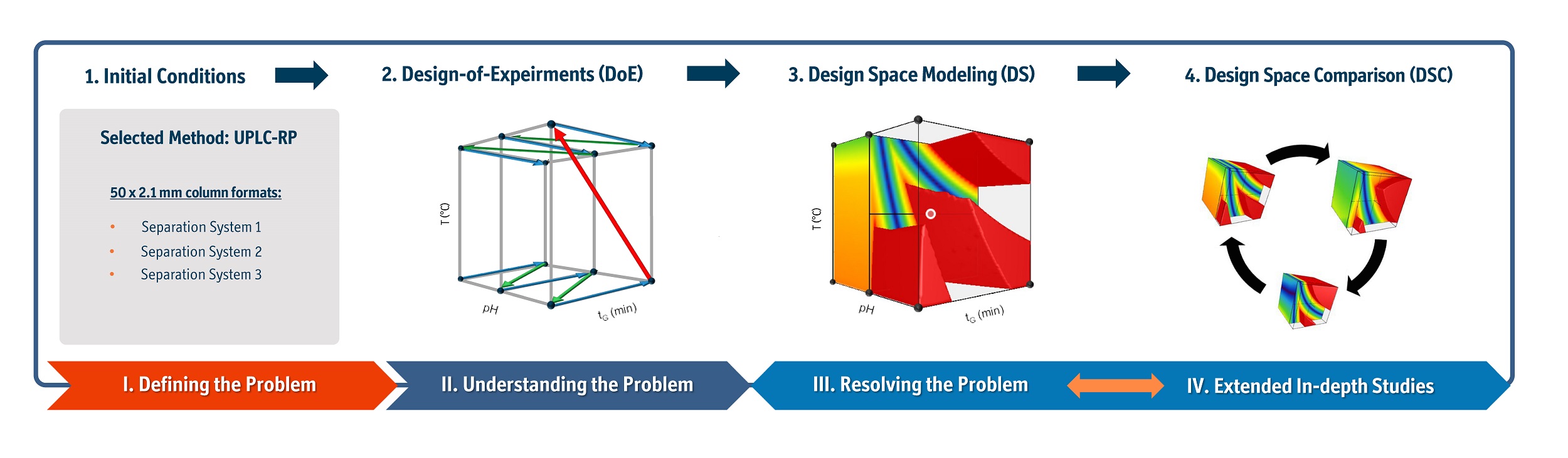
Generalized modeling scheme used across the Design Space studies. Multidimensional separation models have shown exceptional value in characterizing and comparing chromatographic systems in pharmaceutical analysis.
Related Articles