By Molnár-Institute for…
Subscribe to Supplier
Subscribe to Supplier
Novel ion-pair reversed-phase IP-RPLC method for separating oligomers
A recent proof-of-concept study introduced a novel ion-pair reversed-phase liquid chromatography (IP-RPLC) method combined with DryLab modeling, demonstrating significantly enhanced separation performance for oligonucleotides. This study holds particular relevance for the pharmaceutical and biotech industries, as oligonucleotides are playing an increasingly important role in both therapeutic and analytical applications.
The study, titled “Weak to strong ion-pair gradients to expand the selectivity of oligonucleotide separations in reversed phase liquid chromatography – A proof of concept” was authored by Waters Corporation scientists Szabolcs Fekete, Mateusz Imiolek, and Matthew Lauber, and published in the Open Journal of Chromatography.
Dual IP-RP gradient method to expand the selectivity window
The team set out to address the primary limitation of traditional ion-pair reversed-phase liquid chromatography (IP-RPLC): the restricted selectivity range when using only a single ion-pairing agent—typically an alkylamine—combined with a gradient of organic solvent to influence retention through hydrophobic and electrostatic interactions. This approach often results in narrow elution window, limiting separation efficiency.
To overcome this, the study explored a dual-gradient strategy that transitions from a weak ion-pairing agent in the initial mobile phase to a stronger, more hydrophobic agent in the later, organic-rich phase. This “weak-to-strong” gradient substantially broadens the elution window, enabling improved resolution of oligonucleotides (ONs) with varying lengths, sequences, and modifications.
A distinctive feature of the study was the integration of Molnár-Institute’s DryLab® analytical modeling software, operated on Waters platforms, to design, predict, and optimize chromatographic conditions. By simulating different gradient times and temperatures, DryLab® allowed the team to efficiently map and visualize the multidimensional design space. This predictive modeling approach reduced experimental workload and guided the fine-tuning of method parameters to maximize separation performance.
Enhanced resolving power with concave gradient profiles
Experiments were conducted using short (20 × 2.1 mm) reversed-phase columns, with a preliminary concave gradient profile developed to demonstrate enhanced resolution within a shorter analysis time. Significant improvements were observed in the separation of closely related ONs, including sequence and size variants.
Importantly, the researchers found that by adjusting both the ratio of weak and strong ion-pairing agents, along with gradient slopes and temperature, they could flexibly tailor separations to target specific ON length impurities, like truncated sequences. This approach aligns closely with Quality by Design (QbD) principles in pharmaceutical analysis, emphasizing robust method development and well-defined control strategies.
Mapping selectivity changes within virtual design spaces
DryLab®’s ability to map selectivity in silico created a richer method development space, enabling the fine-tuning of chromatographic behavior to meet specific analytical objectives and facilitating the separation of complex mixtures that were previously challenging. The authors highlight the potential impact on oligonucleotide-based therapeutics, where resolving modified residues and impurities is essential for both purity assessment and regulatory compliance.
This proof-of-concept study lays the groundwork for broader implementation in pharmaceutical laboratories and biopharma platforms. The combination of dual ion-pair gradients and optimized gradient profiles offers a versatile, scalable approach suitable for modern IP-RPLC systems. The researchers further noted that applying more complex concave (logarithmic) gradient profiles could enhance separation efficiency, enabling faster analyses while improving resolution.
As oligonucleotide-based therapies continue to expand—particularly with the growing interest in siRNA, mRNA, and antisense oligonucleotides—such application methodologies may provide a robust solution for addressing analytical challenges in characterization and quality control.
About The MOLNÁR-INSTITUTE
Founded in 1981, The MOLNÁR-INSTITUTE develops DryLab®4, a software for UHPLC modelling for a world-wide market. Its powerful modules gradient editor, peak tracking, automation, robustness and Design Space Comparison allow for the most sophisticated method development as required across modern pharma industries. Analytical scientists use DryLab®4 to understand chromatographic interactions, to reduce analysis time, to increase robustness, and to conform to Analytical Quality by Design (AQbD) principles, according to the recently published ICH Q14 regulatory framework.
The MOLNÁR-INSTITUTE is a registered partner of the US-FDA, CDC and many other regulatory bodies. DryLab®4 pioneered AQbD long before regulatory agencies across the world encouraged such submissions. Widely implemented by thought leaders, the software contributes substantially to the paradigm shift towards a science and risk driven perspective on HPLC Quality Control and Assurance.
Further information at: http://www.molnar-institute.com/
Resources
Click on Journal of Chromatography Open: Weak to strong ion-pair gradients to expand the selectivity of oligonucleotide separations in reversed phase liquid chromatography – A proof of concept to read full study.
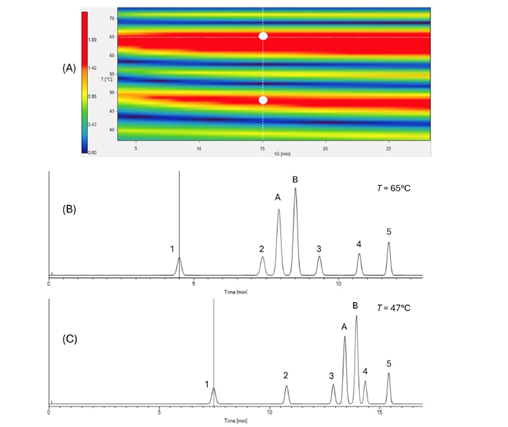
2D resolution map with corresponding chromatograms for a mixture of oligo dT ladder and siRNA single strands. On the color-coded resolution map, the red area indicates baseline resolution conditions while dark blue areas correspond to low resolution conditions.
Related Articles