By L.B. Bohle
Subscribe to Supplier
Subscribe to Supplier

Inside Plant 4 – L.B. Bohle’s BRC Dry Granulators Take Shape
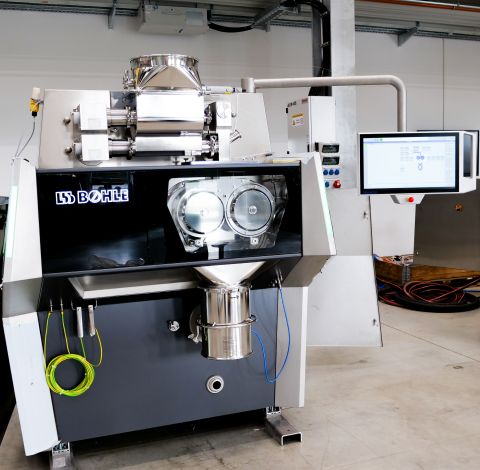
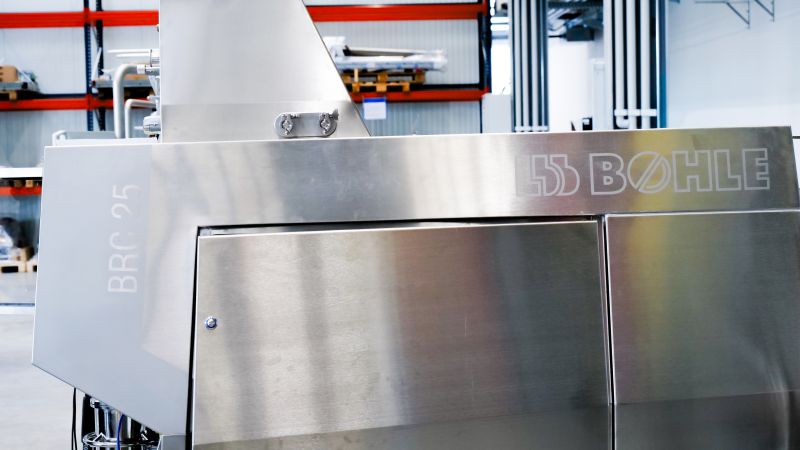
L.B. Bohle’s youngest factory, Plant 4 in Ennigerloh, is busy building BRC dry granulators. A BRC 25 fitted with a conical sieve currently stands on the floor next to a larger BRC 100 with a rotary sieve. Both meet demand for dry granulation in oral solid dose (OSD) production.
Production at Plant 4 started in March 2022. It is a 2,000 m2 production complex dedicated to building machines for continuous manufacturing, sustainable with heat-pump office heating and LED lighting throughout.
Dry granulation with advantages to wet granulation
Unlike wet granulation, BRC roller compaction needs no energy-intensive drying. This saves on equipment and production rooms and lowers the cost per batch. The BRC 25 handles up to 100 kg/h and the BRC 100 up to 400 kg/h, depending on product.
BRC advantages
- Electromechanical drives, with no hydraulics, for consistent flake properties
- Low fines content in the granules, so no recirculation is needed
- Assembly or disassembly in under 10 minutes, almost tool-free
- Integrated Wash-in-Place (WIP) nozzles for effective cleaning
- Flexible sieve set-up, switching between sieve types in minutes
- PAT-ready, with optional containment equipment
Flexible sieving for precise particle size
Milling and sieving have a major effect on final particle size. Every BRC comes as standard with the Bohle Turbo Sieve (BTS), a conical sieve whose interchangeable inserts size granules gently and precisely, even at high throughputs. For different process or product requirements, the BRC can be quickly converted to the mobile, space-saving Bohle Rotary Sieve (BRS).
Resources
Click on L.B. Bohle BRC Dry Granulator for further information and resources.
Visit Bohle Technology Center and Service Center virtually in a 360° tour.
Related Articles