By Bachem AG
Subscribe to Supplier
Subscribe to Supplier

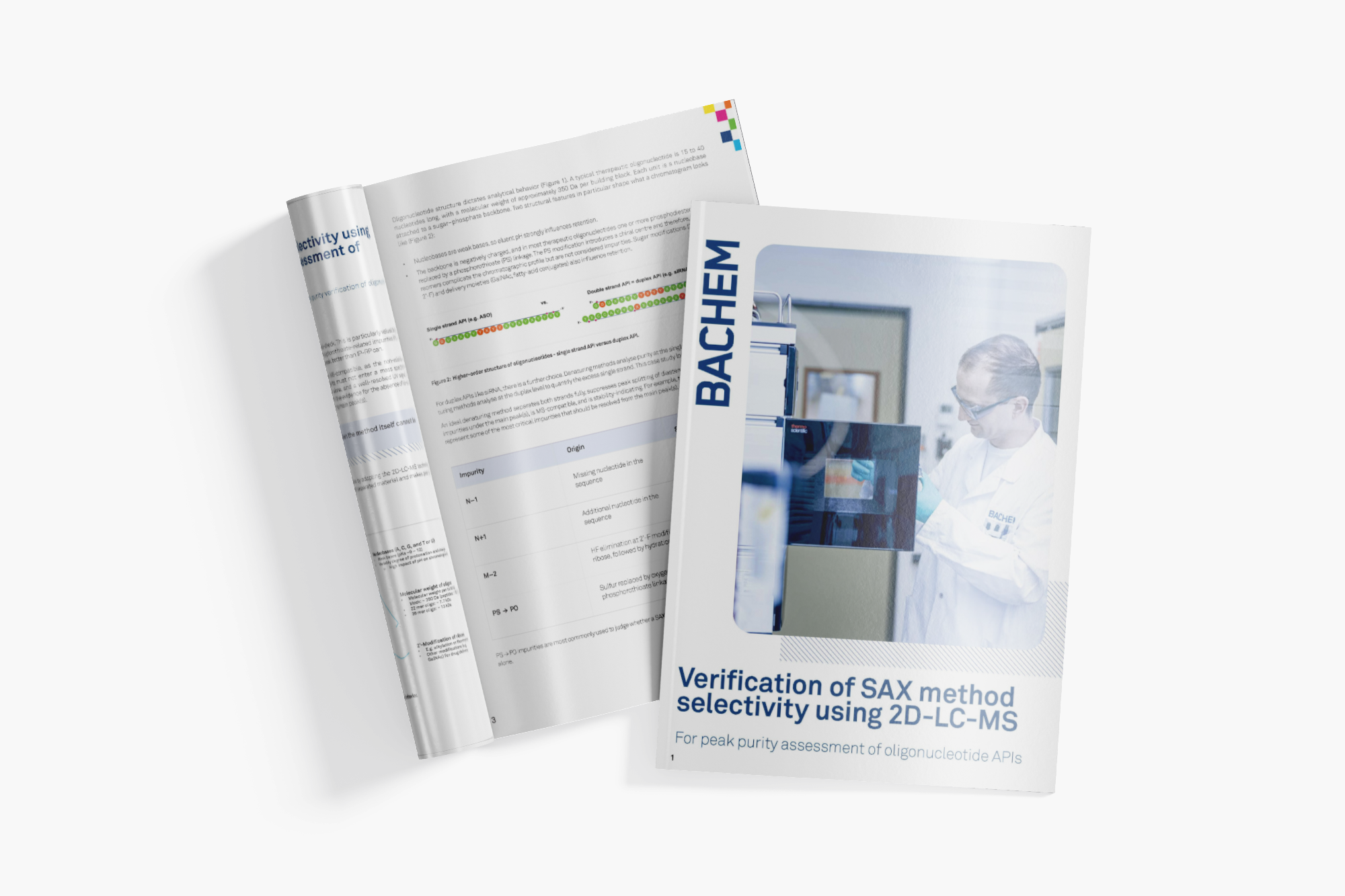
Bachem case study presents new method for verifying oligonucleotide peak purity
Bubendorf, Switzerland – A new case study from leading CDMO Bachem details a two-dimensional liquid chromatography–mass spectrometry workflow for verifying the purity of oligonucleotide peaks separated by strong anion exchange (SAX) chromatography.
The workflow combines SAX fraction collection with mass spectrometry-compatible ion-pair reversed-phase (IP-RP) chromatography, enabling potential co-eluting impurities within apparently pure SAX peaks to be identified.
Overcoming an analytical challenge
This latest advance forms part of Bachem’s continuing drive toward more accurate analytical characterization throughout oligonucleotide development. It supports impurity profiling and stability assessment, ultimately contributing to the delivery of high-quality active pharmaceutical ingredients (APIs).
Strong anion exchange liquid chromatography and mass spectrometry are two powerful analytical tools for characterizing oligonucleotides. SAX is widely used as an orthogonal method to support the purity assessment of oligonucleotide APIs because it separates analytes differently from IP-RP chromatography.
However, the non-volatile salts used in SAX mobile phases prevent direct coupling to mass spectrometry. This makes it difficult to determine whether a seemingly pure UV-detected peak contains co-eluting impurities.
2D SAX–IP-RP–MS workflow
To address this analytical challenge, Bachem has developed a two-dimensional SAX–IP-RP–MS workflow. Bachem describes this as the first method to bring mass spectrometric detection to SAX-separated material, making it possible to verify the peak purity achieved by a SAX method.
The workflow involves collecting individual SAX fractions and reanalyzing them using MS-compatible IP-RP chromatography. This enables MS-based assessment of peak purity and provides additional confidence in SAX method performance.
siRNA case study
The case study demonstrates the application of the method to a representative duplex small interfering RNA (siRNA) API. The workflow was used to evaluate SAX main peaks that would have been classified as pure based on UV detection alone.
The paper explains:
- Why UV detection alone may not be sufficient to confirm the purity of SAX main peaks and how co-eluting impurities can remain undetected
- How the 2D SAX–IP-RP–MS workflow enables MS-based evaluation of SAX peak purity
- How the workflow was applied to a duplex siRNA, revealing PS → PO, methylation, and des-/endo- species beneath the antisense SAX main peak
- Why the method is positioned as a development and verification tool that strengthens the routine release strategy without changing it
- How 2D SAX–IP-RP–MS fits within Bachem’s broader analytical capabilities for oligonucleotide development programs
The case study can be downloaded from the Bachem Knowledge Hub via the link under Resources.
About Bachem
Bachem is a leading, innovation-driven company specializing in the development and manufacture of peptides and oligonucleotides. The company, which has more than 50 years of experience and expertise, provides products for research, clinical development, and commercial application to pharmaceutical and biotechnology companies worldwide and offers a comprehensive range of services.
Bachem operates internationally with headquarters in Switzerland and locations in Europe, the US and Asia. The company is listed on the SIX Swiss Exchange.
For further information, see www.bachem.com
Resources
See Case study: Verification of SAX method selectivity using 2D-LC-MS for peak purity assessment of oligonucleotide APIs to access the full technical paper.
Click on Bachems News to see latest News & Events.
Related Articles