By enGenes Biotech…
Subscribe to Supplier
Subscribe to Supplier
Rethinking Plasmid DNA Manufacturing – Improving Productivity, Downstream Efficiency and Scalability
The growing use of plasmid DNA (pDNA) in gene therapies, viral-vector manufacturing, DNA vaccines and mRNA production is increasing demand for reliable, scalable pDNA supply. As programs progress toward clinical and commercial manufacturing, however, the challenge is no longer simply producing plasmid DNA. Manufacturers increasingly need to produce more pDNA from existing infrastructure, recover it efficiently, and scale production without proportionally increasing manufacturing complexity and cost.
Traditional Escherichia coli (E. coli) production platforms have supported plasmid manufacturing for decades, but limitations in strain productivity, downstream complexity and process efficiency continue to restrict scalability and manufacturing economics.
enGenes Biotech is addressing these challenges through an integrated approach that combines advanced microbial strain engineering with optimized downstream processing. Its proprietary enGenes eXcess™ technology, together with improved lysis and purification strategies, has demonstrated significant potential to increase plasmid yields, improve recovery, and simplify manufacturing workflows.
Here we discuss the challenges facing plasmid DNA production – and how next-generation approaches are transforming process performance.
Why has plasmid DNA manufacturing become such a critical challenge?
Plasmid DNA has become a fundamental component of modern biopharmaceutical manufacturing. It serves as a key starting material for gene therapies, DNA vaccines and viral vector production, as well as providing the DNA template required for in vitro transcription (IVT) of messenger RNA (mRNA).
Plasmid DNA manufacturing can become a significant bottleneck when therapeutic programs move from early development toward clinical and commercial manufacturing and require substantially larger quantities of high-quality pDNA.
At this stage, the key question is no longer simply whether pDNA can be produced. Manufacturers need to consider how much plasmid can be produced per unit of fermentation capacity, how efficiently it can be recovered, how many downstream operations are required, and whether the process can be scaled reproducibly.
A process that performs adequately at laboratory scale may therefore become increasingly costly or capacity-intensive as demand grows.
For manufacturers producing pDNA internally, these factors can directly affect facility utilization, manufacturing timelines and cost of goods. For companies preparing to internalize pDNA production, they can also influence the required scale and design of the manufacturing process.
What are the main bottlenecks in conventional plasmid DNA production?
Most industrial plasmid DNA processes rely on recombinant E. coli strains grown using batch or fed-batch fermentation, followed by alkaline lysis, clarification and multiple purification steps.
Although this approach is well established, several limitations remain:
- commonly used production strains are not fully optimized for high-yield plasmid manufacturing and high biomass does not necessarily mean high plasmid productivity
- plasmid replication places significant metabolic stress on host cells
- alkaline lysis requires careful control to protect the desired supercoiled plasmid structure
- host cell impurities such as RNA, genomic DNA and endotoxins increase purification demands
- complex downstream workflows with multiple unit operations create substantial product losses and increase processing time
- maintaining the desired supercoiled fraction
As a result, improvements in fermentation titer alone do not necessarily solve the manufacturing problem. True process intensification to generate the largest gains requires coordinated optimization of both upstream production and downstream recovery.
Why is plasmid productivity more important than biomass concentration?
A key limitation of traditional production strains is that cell growth and plasmid replication compete for the same cellular resources. In pDNA manufacturing, maximizing biomass is not necessarily the same as maximizing plasmid output. A production process can generate high cell densities while producing relatively little plasmid DNA per unit of biomass. The enGenes eXcess™ platform has been designed to overcome this limitation through optimized strain engineering and process control. The technology is designed to decouple biomass formation from plasmid production, allowing cellular resources to be redirected toward plasmid production after biomass accumulation.
In comparative studies against the commonly used E. coli DH1 strain, the eXcess™ production strain demonstrated substantially higher plasmid productivity.
Although DH1 achieved higher biomass concentrations, eXcess™ delivered approximately nine-fold higher specific plasmid yield, reaching 36 µg plasmid DNA per mg cell dry mass compared with approximately 4 µg/mg for DH1.
This translated into significantly improved volumetric productivity, with the eXcess™ process achieving approximately 1.17 g/L supercoiled plasmid DNA compared with 0.19 g/L for DH1, while maintaining supercoiled plasmid purity above 90%.
These results demonstrate that optimized plasmid replication efficiency, rather than biomass generation alone, is a critical driver of manufacturing performance.
The significance of this improvement is not simply a higher laboratory yield. Higher specific productivity can reduce the amount of fermentation capacity required to produce a given quantity of pDNA, potentially improving facility utilization and manufacturing economics.
Why does downstream processing matter as much as upstream productivity?
Increasing upstream productivity only creates value if the additional plasmid DNA can be efficiently recovered.
Conventional downstream workflows involve multiple processing stages, including biomass harvest, resuspension, alkaline lysis, clarification, feed conditioning, ultrafiltration/diafiltration (UF/DF), and chromatographic purification.
Each additional step increases processing time, operational complexity and potential product loss.
To address this challenge, enGenes evaluated an optimized downstream platform designed to streamline plasmid recovery while maintaining critical quality attributes.
The approach combines improved lysis conditions with simplified feed preparation and chromatographic purification, reducing the number of unit operations required. By eliminating several intermediate handling steps – including UF/DF-based conditioning – the process reduces complexity while helping preserve the valuable supercoiled plasmid fraction.
Maintaining supercoiled plasmid DNA is particularly important because this form is an important quality attribute for many therapeutic pDNA applications.
What improvements were demonstrated using the enGenes process?
Downstream optimization can improve pDNA manufacturing in two ways: by increasing the amount of usable plasmid recovered from the fermentation broth and by reducing the number of processing operations required to obtain the final product.
The study showed that combining the eXcess™ production strain with an optimized downstream workflow delivered improvements across multiple critical process parameters.
Compared with a conventional workflow, the optimized process achieved:
- almost ten-fold higher plasmid concentration after lysis
- improved supercoiled plasmid purity after purification
- increased plasmid recovery during downstream processing
- significantly reduced host cell protein and endotoxin levels
- fewer processing steps and a simplified manufacturing workflow
Key results included:
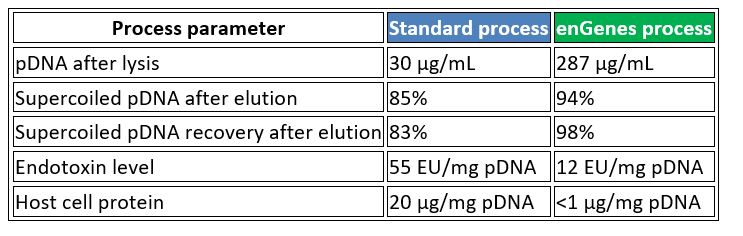
These results demonstrate that downstream optimization can contribute to manufacturing efficiency beyond simply increasing fermentation yield. Higher recovery and reduced impurity burden can reduce material losses, while fewer unit operations can reduce processing time, resource consumption and operational complexity.
How can higher pDNA productivity reduce manufacturing capacity requirements?
Manufacturing capacity is determined not only by the size of a bioreactor but by the amount of usable pDNA produced per batch, the time required to process it, and the efficiency of downstream recovery.
If a process produces more plasmid per unit of biomass, the same target output may be achieved with less fermentation volume. Similarly, improving downstream recovery can increase the amount of usable pDNA obtained from the same starting material.
For manufacturers facing increasing pDNA demand, these improvements can potentially delay the need for additional fermentation capacity or reduce the infrastructure required for a given production target.
This is why pDNA process optimization should be evaluated not only in terms of grams per liter, but also in terms of output per unit of manufacturing capacity, process time and overall cost of goods.
Can continuous manufacturing improve plasmid DNA production?
Conventional pDNA manufacturing is typically organized around discrete fermentation and downstream batches. As demand increases, scaling this model can require larger reactors, additional equipment and increased processing capacity.
Continuous manufacturing offers a different approach. Rather than relying exclusively on increasingly large batches, continuous processes can be designed to maintain production over extended periods, potentially increasing productivity and improving utilization of manufacturing infrastructure.
enGenes has established continuous manufacturing approaches for pDNA production in E. coli, providing a pathway toward more efficient and scalable plasmid production.
For manufacturers with high or growing pDNA demand, continuous processing may therefore offer an opportunity to rethink manufacturing capacity rather than simply increase batch size.
Why should pDNA processes be optimized for scalability from the beginning?
A process that performs well at laboratory scale does not automatically translate into efficient manufacturing at larger scale. Changes in mixing, oxygen transfer, heat transfer, cell density, lysis behavior and downstream material loads can affect process performance during scale-up.
For this reason, pDNA process development should consider scalability from the beginning rather than treating scale-up as a separate final step.
An integrated approach that considers strain performance, fermentation, lysis and downstream purification can help identify scale-dependent limitations earlier and reduce the risk of discovering manufacturing constraints only when larger-scale production is required.
How can manufacturers improve the scalability and economics of pDNA production?
The next generation of plasmid DNA manufacturing will depend on integrated solutions that improve productivity, scalability and economics simultaneously.
The enGenes study demonstrates that combining advanced strain engineering with streamlined downstream processing can significantly improve overall manufacturing efficiency. Higher plasmid productivity reduces the required fermentation capacity, while simplified purification workflows reduce processing time, resource requirements and potential product losses.
By addressing the major limitations of conventional approaches – including restricted productivity, impurity burden and downstream complexity – integrated platforms such as enGenes eXcess™ provide a pathway toward more scalable and cost-effective plasmid DNA production.
The objective is not simply to produce more plasmid DNA. It is to produce the required amount of high-quality pDNA using a manufacturing process that remains economically and operationally viable and secures supply chains as demand increases.
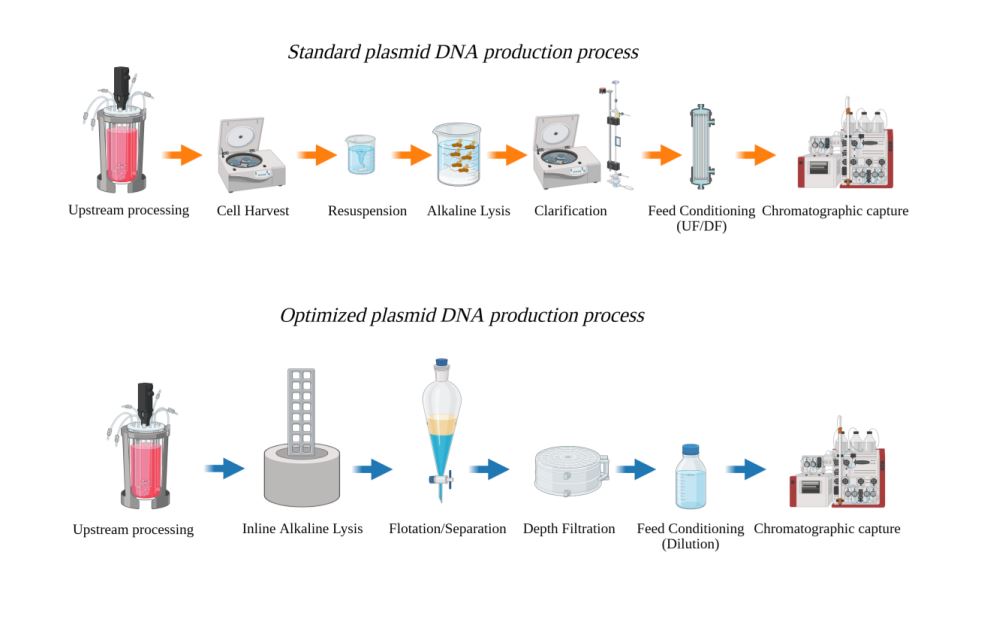
A conventional alkaline lysis and purification workflow including cell harvest and ultra-/diafiltration compared with an optimized lysis protocol combined with a streamlined chromatographic platform.
Related Articles