By Gasporox AB
Subscribe to Supplier
Subscribe to Supplier

Gasporox points to rising inline CCIT adoption as pharma industry moves to prevent costly quality losses
Lund, Sweden: Gasporox AB reports that increasing numbers of pharmaceutical manufacturers are adopting inline container closure integrity testing (CCIT) to prevent multi-million-euro losses caused by late detection of container quality issues.
Traditional quality control (QC) methods still rely on manual deterministic sampling, inspecting only a small proportion of containers and providing no real-time feedback. When closure or sealing defects are detected only after production is complete, manufacturers face unnecessary waste, compliance risks, and significant financial setbacks.
Shared quality challenges
Gasporox, a global leader in laser-based headspace analysis, has compiled case studies revealing commonly shared packaging quality issues across multiple production sites. The most serious involve defects detected only after batch completion, where losses can exceed €1 million per incident.
Additional costs may arise from GMP compliance breaches or even more expensive product recalls.
At the heart of these problems is traditional reliance on destructive, time-consuming manual testing that leave significant blind spots, creating both financial and reputational risks.
Shifting industry attitudes toward CCIT
Industry attitudes are now shifting as new technology enables more reliable, efficient solutions. Gasporox has seen growing demand for its inline non-destructive CCIT solutions based on tuneable diode laser-absorption spectroscopy (TDLAS) technology.
These solutions provide manufacturers with fully real-time, non-destructive headspace gas CCIT inspection directly on the production line at packaging rates of up to 600 per minute.
“We see a clear shift toward in-line process control in pharma packaging,” said Gasporox CEO Märta Lewander Xu. “Inline CCIT enables immediate corrective action while ensuring full compliance with current packaging quality regulations, reducing waste, improving sustainability, and protecting product integrity,” she said.
The Gasporox solution
Gasporox has developed a suite of inline headspace analysis systems designed for seamless integration with existing production lines.
These include the acclaimed VialArch™ module for injectable vials and the recently introduced BottleArch™ system for larger-volume parenteral or infusion bottles, which can be rapidly fitted to existing packaging lines or now placed alongside the line as self-contained standalone units.
These modules allow real-time, non-destructive inspection of every container, with inline integration without reducing production throughput. Additional advantages include automated detection for immediate corrective action and data recording for regulatory traceability. Together, these provide full compliance with EU GMP Annex 1 and USP <1207> standards.
Results for manufacturers
Case studies of pharma companies adopting Gasporox inline CCIT systems show significant reductions in product losses through earlier defect detection, faster batch release through 100% non-destructive testing, and enhanced regulatory compliance and documentation traceability.
Pharma companies using the new technology also point to greater protection of patient safety and brand integrity, as well as scalable deployment across container types and global facilities.
Growing trend toward inline CCIT
The shift toward digitalized, continuous quality control is now widely recognized as a best practice across the industry. Inline CCIT offers a robust path toward real-time release testing (RTRT) and proactive compliance with tightening global GMP standards.
“Gasporox has played a leading role in pioneering this transition through innovative solutions based on our proprietary laser-based spectroscopy technology, now proven over more than two decades of pharmaceutical applications,” said Märta Lewander Xu.
She urged manufacturers: “Don’t wait until late detection costs you millions. Inline CCIT prevents avoidable waste and ensures total confidence in container integrity — in real time.”
About Gasporox
Gasporox, based in Lund in southern Sweden, develops and manufactures laser-based sensors for integration into in-line inspection and production lines for Headspace Analysis and Leak Detection. Gasporox sensors are also available in various instruments ideal for quality control and at-line inspection of packaging and support many different package formats as highly effective tools for more efficient sample testing and greener production.
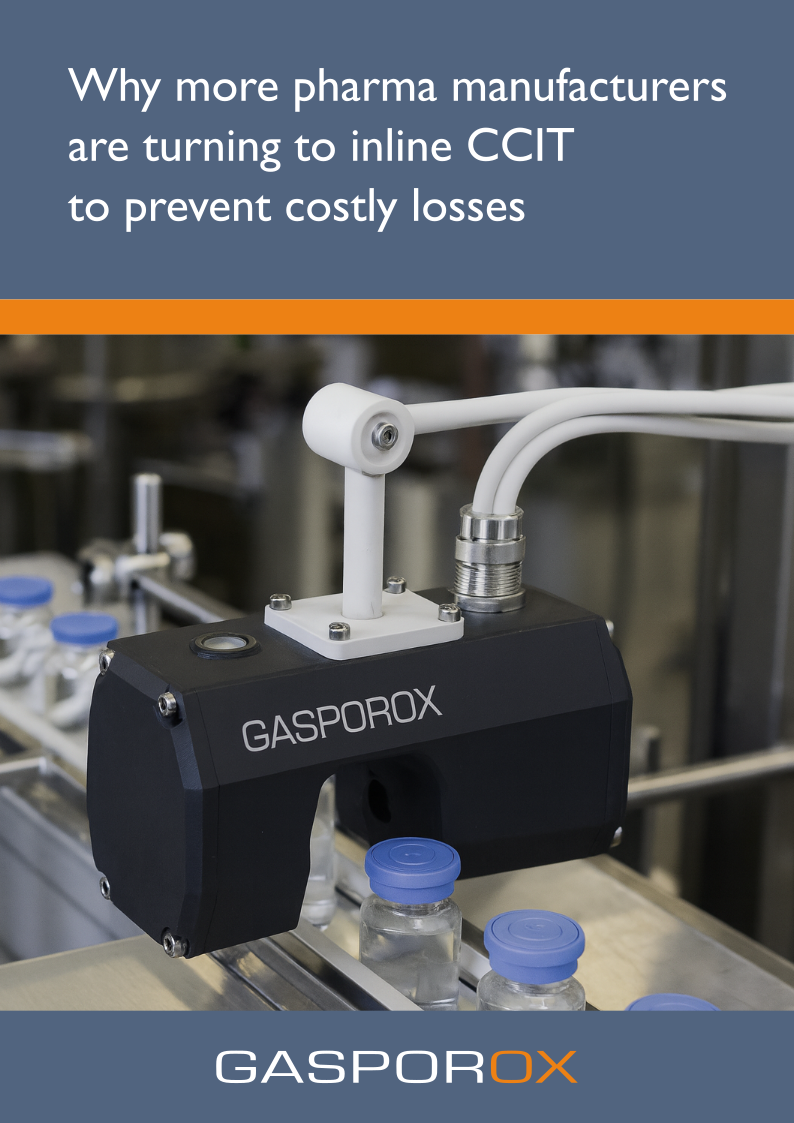
The VialArch™ is a unique laser-based solution for vials to be installed on the production line for 100% quality inspection for residual oxygen and container closure integrity testing. The laser beam is passing the headspace of the moving vials to perform laser-based headspace analysis (HSA), non-destructive and with precise measurements of the residual oxygen in the headspace.
The GPX1500 Film Pharma is a compact and easy to use instrument to measure accurate the headspace of pharmaceutical bags and pouches. It’s designed to operate parameter free to have a reliable and accurate use in the pharmaceutical production and lab. The GPX1500 Vial is the Film Pharma’s sibling for rigid containers, like vials and ampoules.
The available Headspace Analysis sensors work with many types of containers like vials, ampoules, bottles, bags and trays and are available for measuring O2, CO2, H2O, or the pressure inside the inspected container and are suitable for Leak Detection on packages like trays, bags. These sensors can be integrated into production machines or form the basis for stand-alone instruments.
Gasporox technology has been proven for performance and robustness over more than a decade in the pharmaceutical industry in the testing of parenteral drugs. It is integrated and used in machines, systems and instruments for total lab and production testing of vials and ampoules in many parenteral packaging lines.
Gasporox testing technologies are non-destructive and deterministic and recommended by <USP1207>.
Learn more at: www.gasporox.com
Resources
Click on Why more pharma manufacturers are turning to inline CCIT to prevent costly losses to learn more.
Related Articles