By Gasporox AB
Subscribe to Supplier
Subscribe to Supplier

Gasporox Case Studies – effective micro leak detection
Detecting micro-leaks presents one of the greatest challenges in conducting container closure integrity testing (CCIT) in pharma packaging. The challenge is particularly difficult in determining micro-leaks within a reasonable time and without access to expensive laboratory facilities.
Gasporox AB has applied its laser-based non-destructive headspace analysis (HSA) technologies to the problem, using Trace gas Leak Method (TLM) in which a sample is subjected to a carbon dioxide and compressed air mix at overpressure to see how much CO2 enters the headspace.
Case studies confirm effectiveness
Experiments at Gasporox confirm that this deterministic test method is both effective and practicable in tracing and quantifying micro-leaks, as revealed in two case studies now available for download.
Shared findings from the case studies include:
- Clear discrimination between intact and leaking vials in as little as five minutes using only 10% CO₂.
- Quantitative detection of micro-defects down to 10 µm in flexible film packaging.
- Measurable correlation between defect size and gas ingress over time.
- Ability to distinguish true leaks from material permeation.
Such new CCIT testing capabilities provide major benefits for teams working with stability studies, packaging validation, or routine QC, making it possible to detect leaks earlier, reduce uncertainty, and support deterministic methods aligned with USP <1207> and EU GMP Annex 1.
CO₂ tracer gas ingress in flexible film packaging
The first Gasporox study investigated how laser-based HSA could be combined with CO2 pre-treatment in testing flexible film package. Flexible bags, pouches, etc. present specific CCIT challenges, including material permeability, seal variability, and susceptibility to micro-defects. Existing probabilistic methods such as dye ingress and bubble emission testing, or deterministic techniques like High Voltage Leak Detection (HVLD) and vacuum decay can be harder to apply to flexible film formats due to package compliance, material permeability, product conductivity, and test sensitivity limitations for very small defects.
This study evaluated CO2 tracer gas ingress combined with laser-based HSA as a deterministic approach for CCI assessment of flexible film packaging systems, using the Gasporox GPX1500 Film Pharma benchtop testing instrument as the testing platform.
Flexible film bags were prepared with controlled artificial 10 μm, 20 μm, and 50 μm. defects created by precision laser drilling, certified by Oxford Lasers. The drilled bag samples were then exposed to 100% CO2 at 1 bar overpressure for 45 minutes to allow tracer gas ingress through the defects, with a subset additionally subjected to 24 hours of over-pressurization to evaluate permeation.
The samples’ internal headspace CO concentrations were measured on the GPX1500 Film Pharma instrument pre-exposure and afterwards at 1, 5, 20, and 45 minutes after of exposure, with CO2 concentration reported as percentages and evaluated as a function of defect size and exposure time.
The results demonstrated clear correlation between defect size and gas accumulation over time under pressure, with all bags containing defects showed substantial CO2 ingress after 45 minutes, at which point even permeation losses were also quantifiable. Significantly for practical CCIT, measurable differences in CO2 headspace levels were visible even after between 1 and 5 minutes for even the smallest micro-leaks.
This confirmed measurement of CO2 tracer gas ingress using laser-based HSA as a sensitive, quantitative, and deterministic method for CCIT of flexible-film packaging systems. enabling robust and objective detection of micro-defects while distinguishing ingress from material permeation, which is critical for polymeric and semi-permeable systems.
Rapid CCIT of vials using low-concentration tracer gas
The second case study focused on practicable methods for applying overpressure with tracer gas, to answer the most frequently asked question on necessary concentration of tracer gas, time required for test, and degree of discrimination achievable.
For this study, precision wires were introduced between vial and cap to simulate various sized micro leaks before HAS analysis as before, but using low tracer concentration (10% CO2), and short exposure times (5 60 minutes) before measurement of vial HSA using Gasporox GPX1500 Vial instrument.
As before, readings showed clear discrimination, with intact vials remaining at baseline, grows defect (simulated wit 21G needle) resulting in rapidly increasing rapid tracer gas accumulation and micro-leaks discernible within a short time. Again, there was linear correlation between the size of defect and tracer gas accumulation, with clear identification of leaking containers obtainable within five minutes, even for very tiny leaks.
The study demonstrates that reliable and quantitative CCIT discrimination can be achieved using only 10% CO₂ and short exposure times.
Resources
See Rapid Detection of micro-leaks in pharma packaging using CO2 tracer gas for study downloads.
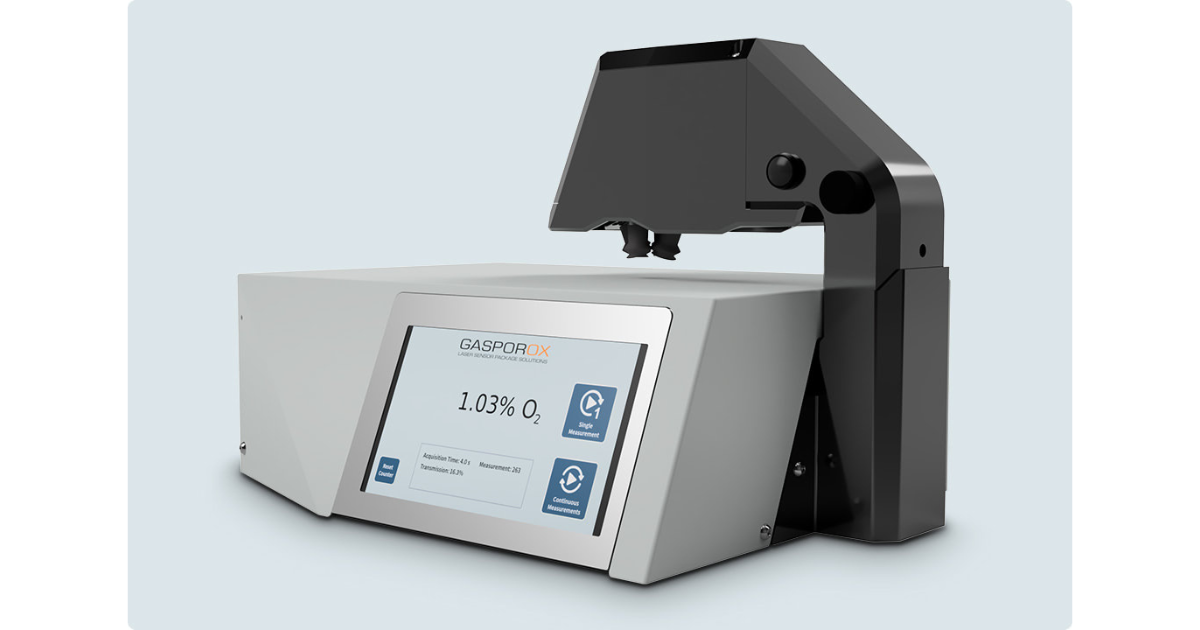
Flexible packaging micro-leak testing platform: Gasporox GPX1500 Film Pharma.
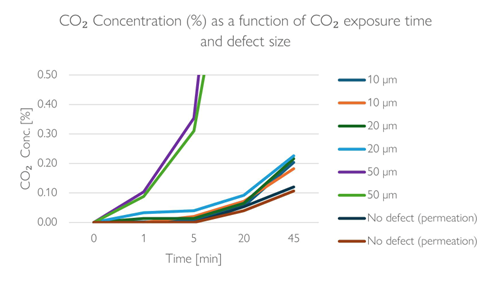
CO2 percentages in flexible packaging headspace showed readings that closely correlated with size of defect.
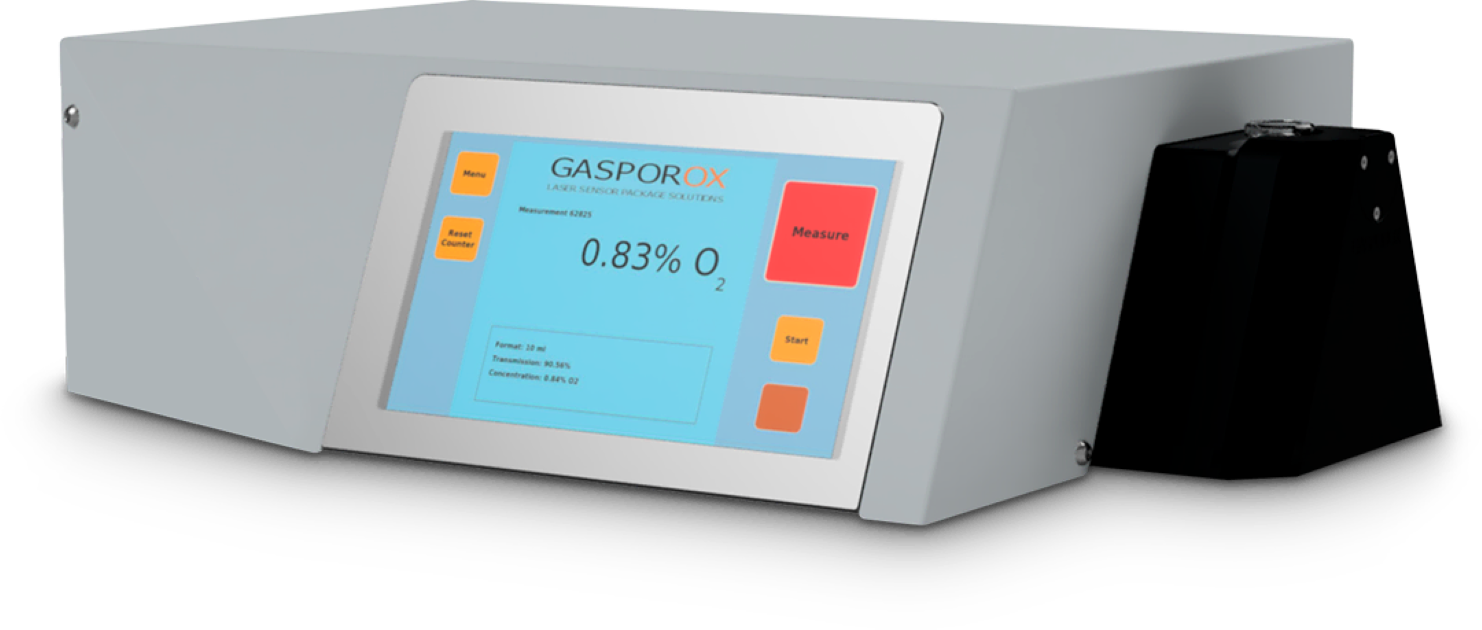
GPX1500 Vial used for 10% tracer gas study.
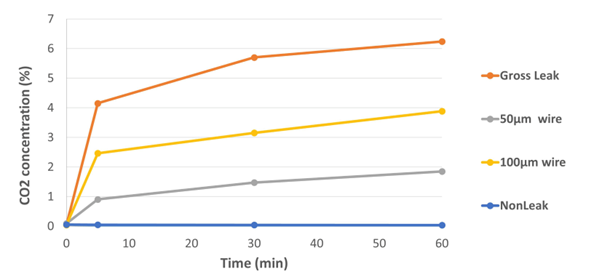
CCIT of vials at 10% Tracer gas concentration: Gas accumulation in test samples varied in direct proportion to size of leak, with variance observable within a very short time.
Related Articles