By nuvalore GmbH

Designing Robust Analytical Methods for Biologics – Moving Beyond Trial-and-Error
As biologics increase in structural complexity, analytical method development must deliver more than acceptable validation results. Methods must remain robust and transferable across development, manufacturing sites, and regulatory review.
For monoclonal antibodies and other protein therapeutics, small shifts in charge variants, structure, or formulation conditions can influence analytical performance. Yet many programs still rely on one-factor-at-a-time experimentation during early optimization. While this approach may identify workable conditions, it rarely reveals parameter interactions or defines reliable operating ranges, allowing hidden variability to surface during transfer, scale-up, or post-approval changes.
A Shift Toward Structured Analytical Development
Regulatory thinking is increasingly aligned with science- and risk-based analytical strategies. Under frameworks such as ICH Q14 and Analytical Quality by Design (AQbD), the focus has shifted from demonstrating that a method works at fixed conditions to understanding how it performs across a defined operating space. Achieving this requires structured experimental design supported by systematic risk assessment.
Design of Experiments (DoE) enables simultaneous evaluation of multiple method parameters, helping identify critical factors, detect interactions, and quantify performance drivers. This knowledge supports definition of a Method Operable Design Region (MODR), a scientifically justified operating space within which analytical performance remains reliable.
For biologics programs, this structured approach improves transfer readiness and supports lifecycle flexibility under increasing regulatory scrutiny.
From Framework to Practical Application
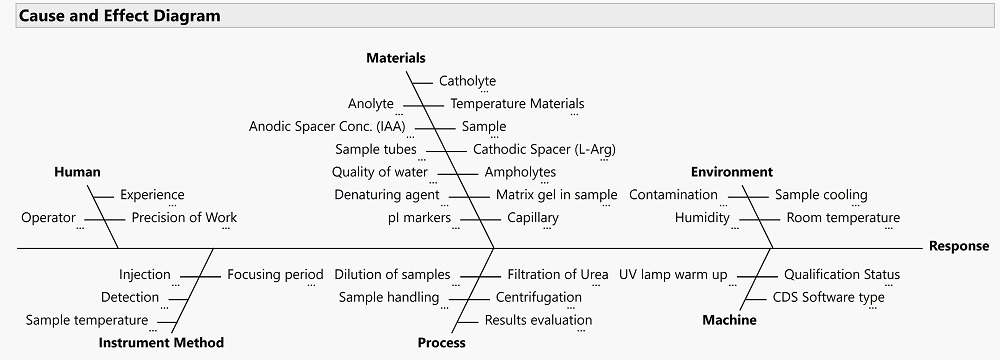
The value of this approach becomes clearer in practice. A recent example involved monoclonal antibody charge variant analysis, with a DoE-driven strategy used to optimize an imaged capillary isoelectric focusing (icIEF) method. The work combined structured risk assessment with fractional factorial DoE screening to evaluate critical parameters and identify interaction effects influencing method performance.
Rather than optimizing a single “best” condition, the study focused on defining interaction of the various parameters and confirming where the method remains robust. The resulting MODR provided a scientifically justified operating space supporting reliable analytical performance.
This work was carried out by Dr. Anamarija Ćurić and the team at nuvalore, a GMP-certified analytical contract laboratory supporting analytical method development for biologics across drug product development and lifecycle management. At nuvalore, Ishikawa-based risk assessment, DoE screening, and MODR definition are used to define operating spaces where analytical methods remain reliable.
Explore the Full Case Study
For discussion of the approach, including Ishikawa-based risk assessment, DoE screening strategy, and MODR definition see the nuvalore blog post Analytical Method Development for Biologics: Using DoE to Build Robust Methods.
The full technical publication describing the methodology is also available via Wiley Analytical Science.
Related Articles