By nuvalore GmbH

Beyond Purity Testing – Why Therapeutic Peptides Require Orthogonal Analytical Characterization
The therapeutic peptide market continues to expand rapidly, driven by growing interest in highly targeted therapies across metabolic disorders, oncology, cardiovascular disease, and other therapeutic areas. While peptides offer many advantages, including high target specificity and favorable pharmacological profiles, they also present unique analytical and quality challenges throughout development and manufacturing.
Unlike traditional small molecules, therapeutic peptides are inherently susceptible to chemical modification, degradation, and manufacturing-related heterogeneity. Even subtle molecular changes can influence product quality, stability, comparability, and ultimately regulatory acceptance.
Purity Alone Is No Longer Enough
As peptide pipelines become increasingly sophisticated, developers are recognizing that purity testing alone is no longer sufficient to fully characterize product quality.
Understanding the Analytical Challenge
Therapeutic peptides can exhibit a wide range of molecular variations during synthesis, purification, formulation, and storage. Common challenges include:
- Sequence-related impurities and truncated peptides
- Oxidation and deamidation
- Isomerization and epimerization
- Charge heterogeneity
- Aggregation and fragmentation
- Process-related impurities
- Stability limitations and degradation pathways
These attributes must be carefully characterized and controlled to support product quality, patient safety, and regulatory compliance. For this reason, regulatory agencies increasingly expect manufacturers to establish robust control strategies around critical quality attributes (CQAs), including identity, purity, impurities, charge variants, aggregates, and stability-related characteristics.
Why Orthogonal Characterization Matters
No single analytical technology can provide a complete understanding of a therapeutic peptide.
Comprehensive characterization requires orthogonal analytical approaches that combine multiple complementary techniques to evaluate product quality from different perspectives.
Chromatographic methods such as RP-HPLC, peptide mapping, ion exchange chromatography, SEC-HPLC, HILIC, and chiral HPLC remain essential tools for assessing purity, impurities, aggregates, fragments, and stability. However, chromatography alone may not always provide sufficient insight into subtle molecular heterogeneity.
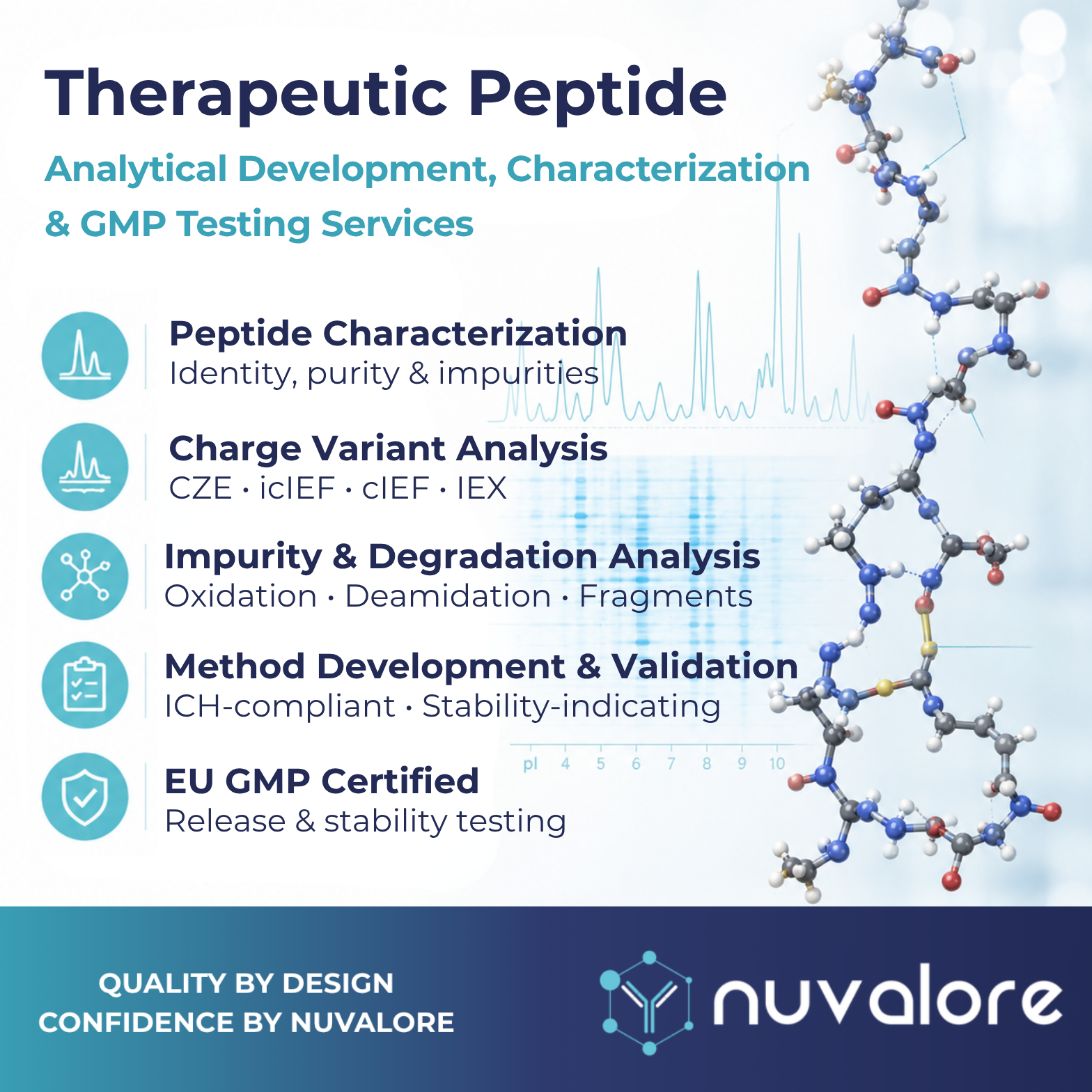
This is where advanced capillary electrophoresis techniques provide significant value. To address this requirement, nuvalore delivers an integrated matrix of orthogonal chromatographic, electrophoretic, mass spectrometry, and physicochemical methods to provide comprehensive characterization of complex peptide assets.
The Growing Importance of Charge Variant Characterization
One area receiving increasing attention across the industry is charge variant characterization.
Even minor molecular modifications can generate acidic or basic variants that influence product consistency, comparability, and long-term stability. These changes may arise from manufacturing processes, degradation pathways, or other chemical modifications occurring throughout the product lifecycle.
Advanced capillary electrophoresis techniques, including imaged capillary isoelectric focusing (icIEF), capillary isoelectric focusing (cIEF), capillary zone electrophoresis (CZE), micellar electrokinetic chromatography (MEKC), nonaqueous capillary electrophoresis (NACE), and CE-SDS, provide valuable complementary information for therapeutic peptides, peptide conjugates, and other complex modalities. By combining chromatographic and electrophoretic approaches, developers can generate a more complete understanding of product quality and support informed development decisions.
Analytical Development Beyond Characterization
Analytical characterization represents only one component of a successful peptide development strategy.
Method development, validation, stability-indicating assays, and GMP testing programs play critical roles in supporting process development, quality control, regulatory submissions, and commercial manufacturing.
As regulatory expectations continue to evolve, organizations increasingly require analytical approaches capable of supporting both development-stage characterization and routine GMP testing within a compliant quality framework.
Aligning with Evolving Regulatory Expectations
Recent peptide-specific regulatory guidance, including the European Medicines Agency’s Guideline on the Development and Manufacture of Synthetic Peptides, further highlights the importance of comprehensive analytical strategies throughout the product lifecycle.
Operating under an EU GMP-certified quality system and supported by Manufacturing and Import Authorization (MIA), nuvalore supports therapeutic peptide programs through analytical development, validation, characterization, and GMP testing aligned with applicable global regulatory expectations.
From Purity Testing to Comprehensive Characterization
As therapeutic peptide pipelines continue to expand, analytical strategies must evolve beyond traditional purity testing to encompass comprehensive characterization of critical quality attributes.
Orthogonal analytical characterization, combined with robust method development, validation, and GMP testing capabilities, provides the foundation for generating regulatory-ready data and supporting successful progression from development through commercialization.
Resources
Connect with nuvalore team
Explore nuvalore services brochure.
Related Articles